How
Much
Cybersecurity
Does
a
Manufacturing
Company
Actually
Need?



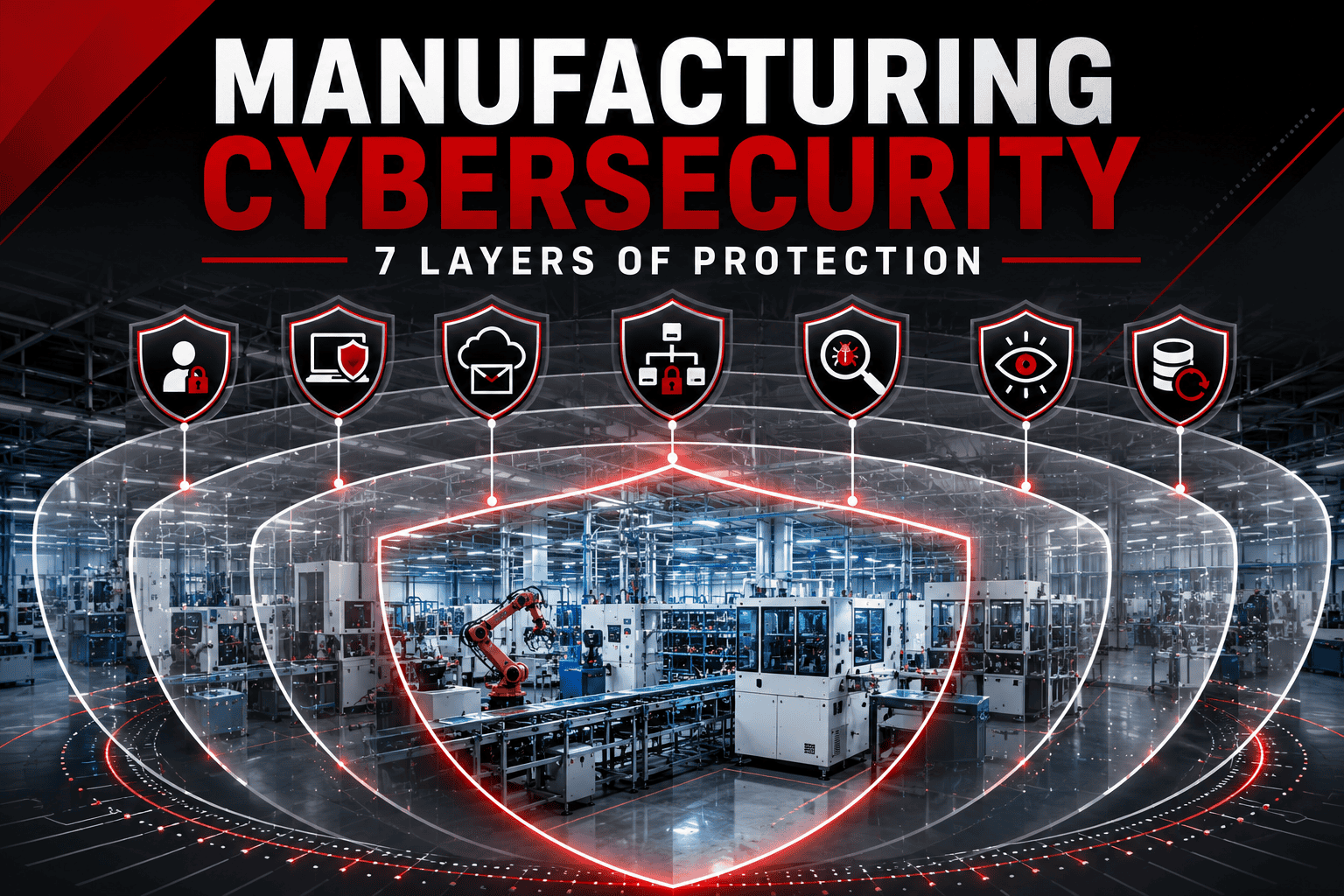
Manufacturers generally need cybersecurity controls across seven layers: identity and access, endpoints, email and cloud services, networks and IT/OT connections, vulnerability management, 24/7 detection and response, and backup and recovery. The depth of those protections should reflect the manufacturer size, technology environment, data, customer requirements, compliance obligations, and the operational impact of a cyber incident.
User accounts serve as primary access points for employees, vendors, and applications. Organizations should implement controls that reduce the risk of theft-related entry.
Multi-factor authentication (MFA) should be used wherever practical for important business systems, particularly Microsoft 365, cloud applications, remote access, administrative accounts, and other externally accessible services.
Account management requires attention to former employee access removal, limiting administrative privileges, and reducing shared accounts. Vendor access through equipment manufacturers and integrators should remain controlled rather than permanently open with shared credentials.
Compliance considerations include CMMC, NIST SP 800-171, customer security requirements, and cyber insurance mandates.
Workstations, laptops, and servers form a major layer of the security environment.
Traditional antivirus remains useful, though modern endpoint protection offers broader visibility. Endpoint Detection and Response (EDR) and related technologies can identify behaviors that may indicate malware, ransomware, credential theft, or other malicious activity.
Organizations should maintain visibility across all protected endpoints. Complexity increases with multiple facilities, remote employees, engineering workstations, shared production computers, servers, and legacy systems. Security programs should not treat antivirus as the complete cybersecurity strategy.
Email connects to identity, data, and business communications, making it crucial for security programs.
Compromised Microsoft 365 accounts potentially expose email, files, contacts, and cloud resources. Attackers may impersonate legitimate users to deceive customers, vendors, or employees.
Manufacturers should combine MFA with appropriate email filtering, account protection, access controls, and monitoring.
Cloud applications require similar attention. A change in hosting location does not eliminate the manufacturer responsibility for access controls, threat monitoring, and data recovery capabilities.
Manufacturing networks include corporate IT, production systems, industrial equipment, IoT devices, cameras, access-control systems, wireless networks, vendor connections, and other connected technology. Those systems should not automatically possess unrestricted mutual access.
Network security employs firewalls, segmentation, access policies, secure remote connectivity, and monitoring. An employee clicking a malicious email attachment on the corporate side of the business should not automatically give an attacker unrestricted access to every connected production system.
Third-party technicians requiring access to a single piece of equipment should not receive broad network access. Manufacturers must document IT/OT connections and determine which communications are essential for operations.
Legacy production systems complicate this landscape. Equipment relying on older software or unsupported operating systems may face significant operational consequences from changes. Segmentation, access restrictions, and monitoring can become especially important when the underlying system cannot be secured in the same way as a modern workstation or server.
Security vulnerabilities continuously emerge across operating systems, applications, network equipment, and technology infrastructure.
Organizations need repeatable processes for vulnerability identification and prioritization. Patch management represents part of broader vulnerability management.
A comprehensive program should clarify:
Manufacturing environments may require additional planning because some systems cannot simply be rebooted during production. Critical systems need scheduled maintenance windows. Legacy applications may not support current operating-system versions. Specialized equipment may require vendor coordination before modifications.
That does not eliminate the vulnerability. It means remediation needs to account for both cybersecurity risk and operational risk.
Preventive controls will not stop every attack.
Organizations require suspicious activity identification when existing controls fail. Managed Detection and Response (MDR), Extended Detection and Response (XDR), security monitoring, and incident response services can provide visibility into activity occurring across endpoints, identities, networks, cloud systems, and other parts of the environment.
Value extends beyond alert generation. Evaluation and response determination matter significantly. Outside-hours monitoring proves particularly critical: manufacturing operations may run second or third shifts, and cyberattacks do not follow the company office schedule.
For manufacturers, the objective emphasizes minimizing the duration of malicious activity without investigation or response.
The final layer is the ability to recover. Managed backups, immutable storage, and a tested recovery process determine how quickly a manufacturer can return to production after ransomware, hardware failure, or accidental deletion.
Backup frequency should reflect how much work the business could afford to recreate. Mission-critical data may warrant backups at least hourly, while lower-priority information may be adequately protected on a daily schedule.
Simplify your IT management with a dedicated partner delivering exceptional support. Tell us where technology is slowing your business down and we will show you exactly how we would fix it, backed by our 6-Month Client Satisfaction Guarantee.